Thursday, December 19, 2013

Neverwhere


Neverwhere
Neil Gaiman, 1996
 Harper Prennial, 370 pgs.

Gaiman never caught my attention before, even when I was in high school while everyone was busy reading his impressively exhausting but incredibly well written comic "Sandman" I was still  getting into Bukowski (cause I thought I was so tragically cool) But recently-after much prodding from several people to get into the "Science Fiction" genre post NaNoWriMo-a fan requested me to give his novels a try. And, after swiping "Bad Omens" from a former lover, (and enjoying the everloving shit out of it. Review to come.) I decided to give it the ol' college try.
After much thought and consideration, I tried him out.
Sadly, I have come to the conclusion that Gaiman's still not for me. Sorry folks!

Neverwhere is Gaiman's first novel about a Scottish man named Richard Meyhew (which hearkens me back to another famous protoganist aptly named Meyhew) who travels to London in order to make a life for himself, he finds himself in a less then amazing job at some sort of white tie law/executive firm, a flat in a normal part of town, and a beautiful, but vain fiancee named Jessica, who only truly cares about her career and image. Meanwhile, a pixie-ish little woman named Door (who can open imaginary and real doors with her magical powers.) is on the run from assassins who killed her family, she ends up trying desperately to search for help.
Worlds collide when Richard and Jessica, en route to a dinner they are running late for, finds bloody little Door lying in the middle of the street. Ever the good man that he is, he essentially tells Jessica to fuck off and brings Door back to his flat to help her. No good deed goes unpunished, however, when Richard is now tossed into the magical underworld of London Below, a place where London's homeless and vagrants reside, and nothing is what it truly seems. Now, they are in a desparite attempt to find out who is truly behind Door's family's death, and why.

Sounds like a fantastic plot. And it is! The first 50 pages really grabbed my attention and I kept reading further to find out more about London Below and the magical cast of supporting characters who are heavily sprinkled throughout. However, about halfway through the story, I started to lose interest. I felt like the story was getting stale and we were dragging our feet towards the end. Which felt a little lackluster and predictible to me. But don't let my bah-humbugness steer you away from this book. Word around the block is that this was Gaiman's first novel, so maybe not the best way to introduce me to his writing style, as his craft was more polished and professional by the time I got to Anansi Boys (Which I also recommend). Also, this book feels like it should be grouped into "Hitchhiker's Guide to the Galaxy" genre because of the simplistic plot line and incrdibly detailed words and characters. Neverwhere and Hitchiker's are both firmly planted into Young Adult Sci-Fi. Where if you didn't read them when you were in your teens, it won't impact you as much when you're an adult.
Another thing I found disenteresting is the humor; I personally- as the case is with me and most British Enterainment- kept feeling like I'm missing a key part of the puzzle, or that I'm not 'in' on an inside joke the entire time. I even had to look up the “Mind the Gap” explaination to actually see if it was truly realistic or if Gaiman wrote it into the book for fun (The anouncemnt, not the creature). Maybe it's because I grew up American and enjoy things handed to me instead of – you know – thinking about it. Maybe it's because I have a Swedish and New England type of dark humor (It's all the snow and the dark, it gets to you after a while.) but I found the humor highbrow and generally dry.
All in all, if you have teens/young adults in your house and you want them to get interested into the world of fantasy and science fiction, you needent look much further than Gaiman's work (although this book is not for children as there is a shit ton of murder, some sexual content very rare, like 2 scenes, and the occasional swear peppered in.)
Postscript - I was just now informed that Gaiman has written some shows for the rebranded Dr. Who series (sigificant other is a Whovian) MIND, FCUKING, BLOWN! So If you needed one more good reason to go read this book, let this nugget of trivia be it.  

Book Haiku:

Main character lost


In magical underworld
Flat British humor

H.P. LOVECRAFT HALLOWEEN SPECTACULAR! A (very late!) PART II: Herbert West, Reanimator

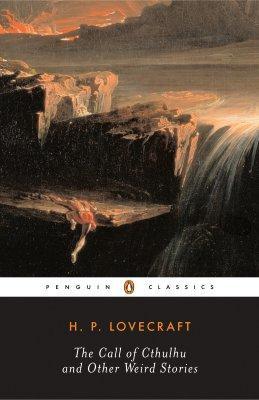
Herbert West - Reanimator. (pgs. 50 - 80)
fromThe Call of Cthulhu and Other Weird Stories
            by H.P. Lovecraft, 1927
              Penguin Classics, 1999, Editor: S.T Joshi

Herbert West is a series of 6 short stories within a short story (very Inception of you Lovecraft!) That focus around one man's plan to reanimate the dead (Read: Zombies) Hilarity ensures when plans go tragically, horribly, laughably wrong. All told by Dr. West's unnamed colleague.

Oh. My. Christ. Those fucking scientists, again.
Will they ever learn? Will they ever just, fucking, STOP? 

Dr West is crazy, just straight up cray. He will stop at nothing to get a fresh body and try out his lifelong experiments on them. Another thing to keep in mind is that his obsession spans from the time he is a college student at Miskatonic University (Actually Lovecraft's first story to mention it, also his first published work for a trashy rag called “Home Brew”.) up until he is a well-established doctor living in Boston a few years after The Great War. This Frankenstienen love affair has been going on his entire adult life. The story gets repetitive the first few paragraphs of very “chapter”, since this was originally a series of monthly stories spanning 6 months. So there was a lot of backstory and summarizing for people who jumped into the middle of the series, but it does take on a unified, loose single plot. Which I enjoyed, since I could put it down between busy times at work/home/life and pick right back up a few hours/days later and know exactly what was going on. (Hey, when you have kids and a stressful full time job, it takes a lot to try and find time to read 30 pages! Be grateful I can produce a book a month. I guess what I'm trying to say is, don't have children, but I'm really digressing here..)

I also found pleasure in how grotesque yet funny the stories were, It was refreshing to read something that wasn't trying to scare you shitless. However, what I found truly disturbing is how Lovecraft described a recently deceased African American man as a tom-tom pounding, gorilla (pg. 63 “Buck Robinson... ...many ugly things.”) I later found out that Lovecraft was an incredibly racist, chauvinistic man who was mostly bedridden his entire life. Also, this was the 1920's where race equality wasn't a big topic of the day, I mean, we barely got women to vote at this point. So I shouldn't really expect much from him. Herbert does get his comeuppance in the end, when the reanimated dead come back in the last chapter, which is really quite funny and I will not to repeat the ending here, but oh man. Go read this story for some ghoulish laffs!

 Book Haiku:

Dead folks are funny

Goddamn Scientists again!

Seriously, Sthap.


Saturday, December 7, 2013

update

Apologies to fans and family (who are pretty much my only fan base right now, thanks for reading mom!) Who have been patiently waiting for the next reviews. I had been participating in NaNoWriMo all last month. On top of this, Thanksgiving, and my birthday, I had to let my blog simmer for a bit.

However, this doesn't mean I haven't stopped reading. I got through the last of my Lovecraft Spactular, but 2 other books as well. "Neverwhere" will post tomorrow morning, along with "Herbert West: Reanimator" to follow in the afternoon.

Upcoming books include:
NH Pulp Fiction's LIVE FREE OR SCI FI
Marisha Pressel's NIGHT FILM
Mark Z. Danielewki's HOUSE OF LEAVES
Neil Gaiman and Terry Pratchett's BAD OMENS

Stay Tuned.

PS - Not only did I finish Neverwhere, but I finally got through the entire Harry Potter book series in less than a year (A personal goal for me). If you are interested in me reviewing the series as a whole (7 posts for 7 books) please let me know in the comments section, my personal Facebook page, or via email.

Sunday, October 27, 2013

H.P. LOVECRAFT HALLOWEEN SPECTACULAR PART I: The Colour Out of Space

The Colour Out of Space (pgs. 170-200)

from: The Call of Cthulhu and Other Weird Stories
            by H.P. Lovecraft, 1927
              Penguin Classics, 1999, Editor: S.T Joshi

Before we get to the review, I a little background on the Lovecraft Halloween Spectacular:

I wanted to get into the spirit of Halloween for quite some time, because my day job sucks the life out of you, days run together, etc. October was flying by and I needed to get into the mood fast. I decided to try to find a great horror story to pick out and review this month. But what would I choose? I had no place to start. I consulted my ever loving, amazing idea-having significant other. Who came up with this idea of a Halloween Short Story Triple Feature on the granddaddy master of everything Horror/Sci-Fi. It didn't take long to convince me, as I have never read a Lovecraft story and I am game to read anything new.
Now, after I had agreed to this Spectacular, I suddenly learned that my significant other is a closeted, RABID LOVECRAFT FAN. This Mofo handed me 2 collections and-when asked what 3 stories to pick-replied “Kelso, That's like you telling me to pick my favorite child.” We finally decided on one I vaguely knew (“Herbert West- Reanimator”) the most popular (“The Call of Cthulhu”) and his favorite (“The Colour Out of Space”) So here we are.

Colour Out of Space is primarily about an asteroid falling next to a well on a farmer's property, then strange shit starts to happen to this family over the course of a year. Like, REAL FUCKING STRANGE SHIT. The story is told by an old man named Ammi Pierce to a much younger unnamed surveyor. Who is scouting the Blasted Heath out in order to put the town's reservoir there in the coming months. Yes. Like, this is the town's drinking and bathing water.
I don't want to go into too many details about what specifically happened to the Nahum family, but they either disappeared or died because of this liquid like magma that oozed out of the asteroid when the incredibly short sighted scientists at Miskatonic University broke open the asteroid that FELL FROM FUCKING SPACE. And just FUCKING LEFT IT ON THIS POOR MAN'S PROPERTY. You will come to understand in later reviews why I believe Miskatonic University should be considered questionable in their studies and practices.


What I really enjoyed about this story is how incredibly atmospheric it feels. From the trees swaying without any wind to the description of the pail and lantern that was found next to the well where a Nahum boy disappeared. It immerses you into this story which makes you want to slow down and take your time with it. Yet the scenes are so intense-like what happens to poor Mrs. Nahum (“...Threw open the low white door.”....”the faint yet unmistakable luminosity of all the woodwork in sight; steps, sides, exposed laths and beams alike!” pg 178-179)  for example-that you want to speed read through it as fast as you can. The very well written and supremely detailed and comprehensive notes the Mr Joshi leaves at the end of the chapter states that this is one of the first examples of Horror and Science Fiction working hand in hand together via the unknown properties of the asteroid and space in general while not having to explain anything about them thus making this story as realistic as possible.

However, I was not prepared for how difficult Lovecraft can be. I knew he was early nineteenth century literature, but I wasn't prepared for such lush language such as grambel, aerolite, foetor, and tungsten contrivances (all of which I highlighted and looked up later). Pair that with paragraphs about how creepy dead trees can be (4 paragraphs in this entire 30 page story) then it becomes pretty muddy if you're not used to it. After re reading several paragraphs and about 5 pages in, I was getting used to the style and started to enjoy the story. I do not recommend Lovecraft for someone who's not a strong reader or if English is not their first language. Have someone else try to describe the scenes for you if you're seriously interested in reading this story. (I had to ask Significant Other about certain scenes to make sure I had the plot right in the very beginning. I know, I'm pretty stupid, but I'm writing a review, I had to get it right!) Bottom line, after re-reading the story a second time, it was a pretty immerse, intense ride. Maybe not the scariest story I've read. But pretty damn creepy.

(WARNING: Don't click that link unless you have headphones on and 20 minutes of free time, it's pretty NSFW) 

Book Haiku:

Creepy atmosphere

Asteroid, pretty colors.

Fucking Scientists.

Sunday, October 20, 2013

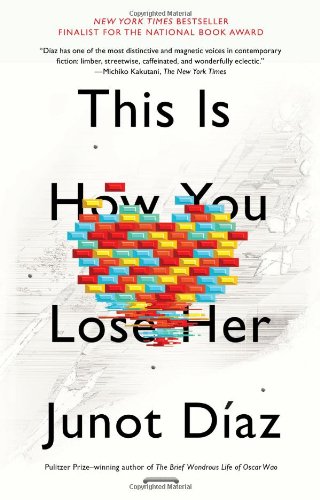
This is How You Lose Her

This is How You Lose Her
Junot Diaz, 2012 
Riverhead Books, 224 pgs.

I'm just going to jump into this, "This is How You Lose Her" is a fantastic book. Period. Here's why...
The book is a series of nine short stories that focus on Yunior's tenuous love life. A misogynistic, but heart-of-gold Dominican Culo who cannot seem to keep his carajo in his fucking pants. The short stories are about his incredibly flawed but strong women that he has loved in his lifetime, whether it be romantic, physical, familial or otherwise.
It's safe to say that this is a testosterone driven book. Yunior is an asshole to the classic degree. He can't seem to keep a relationship together, he is always cheating on his young ladies. In the book we start to see the development of how he treats women via his brother's relationships ("The Pura Principle" pg. 89, "Nilda" pg. 27) his relationship with his mami and how his papi influenced it ("Invierno" pg.119) and other outside influences ("the Cheater's Guide to Love" pg. 173, "Otravida, Otravez" pg. 49). Yet throughout the book, you cannot seem to want to hate him and his womanising ways. This is the culture he grew up in, which is vastly different from out “whitepeople” 's views on relationships. This is not to say that what he's doing to these women are in any way good, but it's good to go into this book understanding that he doesn't purposefully seek out and do harm to his lovers. 

As much as the short story genre is making a comeback in a big way The stories are not what captured my attention as much as they way Diaz writes. My God, can this man WRITE. Every single sentence works, there isn't one word in any of his paragraphs that doesn't have a purpose. You know how sometimes you're reading a book or a paragraph and it feels like some sentences and words were unnecessary fillers? Not this book, Everything flows so beautifully, Case in point, when Yunior gets caught (yet again) cheating, this time by an incriminating journal entry his girlfriend found:

“Instead of lowering your head and copping to it like a man, you pick up the journal as one might hold a baby's beshatted diaper, as one might pinch a recently benutted condom. You glance at the offending passages. Then you look at her and smile a smile your dissembling face will remember until the day you die. Baby, you say, baby,  this is   part of my novel. This is how you lose her. “ 
(Diaz. From “Alma” pg.48)

Yeah I know right?  Fucking, FAN-TAS-TIC!
The short stories don't just exist, they're breathing, beating, alive. I'm in love with this book, and it's not just me. In closing, you need to go read this book. They will change the way you look at literature for months to come. 


Book Haiku:
This book is a treat.
Revel in your heart, breaking.
Forever a fan.


Monday, October 7, 2013

Gone Girl

"Gone Girl – A Novel"
Gillian Flynn, 2012
Crown Publishing Group, 432pgs.


Before we start this review, I must disclose that I am not a Thriller/Mystery person in any sense of the word. I never really gave much thought to the genre and it never really interested me past middle school. By that time I was reading Christopher Pike and R.L. Stine. I had then graduated to Stephen King classics like Gerald's Game and The Shining. But after I reached 16 the genre pretty much died in me. I felt like I could predict the ending to every book I was reading after 30 pages in. It got real boring.

I did not expect the twist in Gone Girl. It was that surprising.

Gone Girl is a multi-layered novel about a marriage gone wrong. Not like, “Oh they're like Ralph and Alice! So degrading but totally acceptable!” Nope.
They're like George and Martha if they were raised by Ted Bundy and Aileen Wuornos. They're THAT kind of fucked up. The book opens with Nick and Amy Dunne on the morning of their 5th wedding anniversary, Amy is cooking breakfast, while Nick appreciates it but then has an overwhelming sense of dread. He then goes to work while Amy does the housewife thing. When he returns, Amy is gone.

What follows is a tilt-a-whrl ride through the next several days while Amy is missing: The police and the TV crews are involved, Amy's diary appears- which is collated with chapters regarding the events that happen while Amy is missing- and paints Nick in a not so wonderful light, a strange but seemingly heartfelt treasure hunt left by Amy on her last few days before her disappearance, and-of course-towards the middle of the book, Nick becomes the number one suspect. Towards the halfway point of the novel, when Nick finishes his wife's annual treasure hunt, is when we get the major plot twist, the twist which I didn't expect (not fully, at least). Because I do not condone spoilers in my book reviews, I will have to leave quite a bit of themes and explanations out of the plot synopsis. I apologize for this, but the book will be so much better if you go in knowing as little as possible. The impact is better if you don't know what's going on.

What I will go into, however, are the two main characters. I have hated both main characters the entire book. They are vile human beings. Nick is an untrustworthy, selfish, mamma's boy, who blames his problems on everyone but himself. He is also untrustworthy as a narrator, knowingly lying to the police and letting us know about it, but he doesn't dish his big secret until 25% into the book. Whereupon it's forced upon him by his twin sister, Go (shortened from Margot). Who, by the way, is the only redeeming character in this book, and even she is very flawed. Amy on the other hand, is something else entirely. Even her diary entries which make her seem like a helpless flake do nothing for her personality. The relationship they have throughout the book (both before and after Major Plot Twist) is incredibly toxic. It makes for a fantastic story but I felt like I couldn't get into the book as much as I'd like because the main characters are two wholly unlikable people with no credible reason to like either of them.

The story line and plot for this book surprised me as well, it was fucking GREAT, it was one of the best plot lines from a mainstream book I've read in the last 3 years. It really hooks you in, drags you into dullness for a few chapters, whereas I'm white knuckling pages so I don't try to skim and get to “the good stuff” then-suddenly-a new development appears! And I'm forced into a 20 page reading spree until the next lull happens. I enjoyed that feeling, this was a fun sidetrack to go down and braking down my typical, go to, genres I read most of the time. I came into this book thinking it wasn't going to be that grand (Some of the few thoughts going into this novel: IT'S A MAINSTREAM, THRILLER, MYSTERY NOVEL!!! IT'S GOING TO BE ANOTHER JAMES PATTERSON/SUE GRAFTON TRASH BOOK, OMG WHY AM I DOING THIS TO MYSELF? Mind you, someone in my steno pool said this and Fifty Shades of Grey were required reading for her. I will not stand here as a lover of Literature and self-proclaimed book lover and tell you that Fifty Shades is a book you should be reading, but if you're tired of reading the same genres and are looking for something a few steps above the Alex Cross/Kinsey Millhone bullshit trade paperbacks, then I highly recommend this book.


Book Haiku

Unraveled marriage

Unbelievable Assholes

Unexpected end

Sunday, September 22, 2013

The Fault in Our Stars


"The Fault In Our Stars"
John Green, 2012
Dutton Books, 318 pgs
.


At first when I picked up this book, I was all about it. I fell in love with the quotes that exploded on Tumblr and Pinterest when this book first came out last year. I'm a quote whore, (You can thank my mom for this.) But I digress, I've also heard a lot of good things from a few of my friends about how hard they cried at the ending (somebody dies, FYI) and it was the best Y/A fiction that has come out in recent years. It also had a reserve list about ten deep at the library. Needless to say, this was a hot book that I shouldn't pass up.
But I was dead wrong.
(Too soon?)

This book is basically "Hipster Kids with Cancer: The Book." We center on Hazel Grace, a 16 year old teenager who has had Thyroid cancer, with aggressive colonies in her lungs. Her parents believe her to be clinically depressed and decide to make her go to a Support Group in "The Literal Heart of Jesus" (A.K.A a church basement, but they're teens, you know?) There she meets a brooding, mysterious, tall, dark, handsome, type named Augustus Waters. Who spends his time acting nonchalant, cocky and ponders existentialism to the point of hilarity. They eventually fall into teenager-y love but they both decide they have Romeo and Juliet Syndrome (I love you so much that I don't want you to be hurt when I'm dead, so I'm just going to be incredibly sad and forlorn about it the entire goddamn book.) They end up sharing a passion for an author named Van Houten and this Catcher-in-the-Rye-but-with-cancer-esque masterpiece "An Imperial Affliction".  The fictional novel ends on a cliffhanger which they SO TOTALLY CANNOT OMG GET OVA, and they decide to go track down Van Houten together by the Magical Powers of the Genies (Think: Make a Wish Foundation) They trek off on a whirlwind adventure to Amsterdam. Sadness/melodrama ensues.


I tried really hard to enjoy this book, really, I did. But the kids really try hard to be smarter than they actually are. This does work for them since they’re dealing with a stressful and serious subject such as their own mortality. I don't blame Green for writing the characters with this deep sense of trying to figure it all out. I give him props for mixing the dread and heaviness of having a terminal illness with the emotional, irrational, hormonal time that is adolescence and it works well in some scenes (see pp. 121-125 the swing set.) but it loses its natural flow after “Night of the Broken Trophies.” (pp. 62) after that, it feels choppy and unwarranted in places (see pp. 204-208 the Venn diagram.)

Another problem I had with this book was the characters. I found them incredibly annoying and lacking quite a bit of complexity-which is sad because he could have gone SO FAR with this topic. Maybe it's because the characters need to be a bit simpler and straightforward in YA Fiction but I suggest he give his audience something better than a kid who puts unlit cigarettes in his mouth because “It's a metaphor.” (pp. 20, at this point I almost put the book down.) And a main female character that fears oblivion quotes 2 famous poets but obsesses to the point of biblophilia mockery over the lack of ending in her favorite novel. Especially when he decides to enlighten teenagers with explanations of Maslow's Hierarchy of Needs (pp. 212) Pompeii (pp.220) and Philippa Foot's Thought Experiment (pp. 286). As well as peppering in as many uses of the word “hamartia” as he could fit into one novel (I counted 9, maybe more.)

Things that I actually enjoyed? Ehhhh....Well, it's a very quotable book. There are some really good, kinda romantic and sorta deep quotes that I highlighted because I thought they were well written. Speaking of, some of the scenes in Amsterdam and a few more towards the end of the book; He really did capture moments with such simple description and powerful emotion without being too over the top or going over the heads of a young audience. (Chapter Twenty pp. 253-260.) Only scene where my eyes moistened a bit, and pp.201-204 Otto Frank scene.)

All in all, if I was 14 or 15 again, I think my nerdy, intelligent, hopeless romantic self would have enjoyed this book. Maybe because I'm 25 and I am broken by spirit crushing events that caused me to be an incredibly cynical bitch. Maybe the cringe inducing fact that I kept thinking  some of the scenes were melodramatic and terrible because I did those same gestures in middle/high school and thought I was the fucking COOLEST most badass person EVER.  Because 15 year old me would have been so smitten with a dude who kept unlit cigarettes in his mouth because it was a metaphor. And I am embarrassed by this.


You really shouldn't be turned off by this book if you have teens of your own, I recommend it if you can suspend disbelief and get over the fact that these kids are just that. Kids with cancer. Or if you would like to read a “smart” Y/A novel that tackles with death and the precious beauty of life. Then you should turn around and give your kid some Bukowski and a handle of whiskey. Because man, they'll be halfway there.


Book Haiku

Two kids with cancer

Finding love in Amsterdam

Predictable ending